
Choral

Workshopping in Lichfield

The Lichfield SingersThe Lichfield Singers

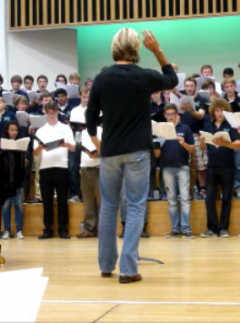
I had a happy and productive afternoon on Saturday with the Lichfield Singers, doing a workshop on the theme of Rethinking Choral Musicianship. One of the benefits of customising these workshops to individual choirs is that not only do they get the workshop time focused on the music they are currently working on, but the things we learn together are also specific to that occasion. I love that sense of knowledge arising from a particular context, and the feeling that we all go home slightly changed from when we arrived after the experience of working together.

Jackie Roxborourgh on Types of Choir

Another session from August’s ABCD Convention that deserves individual comment is Jackie Roxborourgh’s session on community choirs. Jackie works in the world of natural voice practitioners, and so probably spends a lot time helping the people ABCD delegates were referring to as the ‘generation lost to singing’.

One of the (many) things I liked about her approach is that her focus is in helping people over the obstacles they have had with singing, whether that be childhood discouragement or exclusion in adulthood due to a lack of music literacy. So she sees it as a badge of success when people move on into other choirs – such a refreshing difference in attitude from the hoarding of members and jealousy if they ‘defect’ that you so often see.

Anyway, part of her discussion involved a compare/contrast exercise of the ‘traditional’ choir versus the ‘community’ choir.

Eric Whitacre with the National Youth Choir of Great Britain

whitacreA session at last month’s ABCD Convention that deserves a post of its own was the one in which Eric Whitacre rehearsed the National Youth Choir of Great Britain in his new piece ‘Alleluia’, in anticipation of its performance in the Gala Concert that evening. Whitacre is a composer that a few years ago would have been described as ‘definitely flavour of the month’, but is now reaching the level of popularity that Kathy Sierra characterised as the ‘koolaid point’.

That is, he is sufficiently successful that you get people reacting against him, dismissing him as some combination of too groomed in his presentation, formulaic in composition, or just plain over-sung. While some people swoon at the thought of meeting him, others grumble that you have to look like a film star to be a composer these days. So, it was interesting to see him in action.

Happy Birthday to ABCD

Friday night's panel: Brian Kay, Amy Bebbington, Neil Ferris, Jackie Roxborough, Helen Smith, Rachel Greaves, Pamela Cook and John RutterFriday night's panel: Brian Kay, Amy Bebbington, Neil Ferris, Jackie Roxborough, Helen Smith, Rachel Greaves, Pamela Cook and John Rutter
The last weekend in August has become the traditional weekend for the Association of British Choral Directors to hold their annual convention. This year’s was on my home patch in Birmingham, and was celebrating the organisation’s 25th anniversary.

The plenary sessions on Friday evening and Saturday morning accordingly took an overview of British choral life – the first looking at trends from the last 25 years (and into the future), the second considering the ‘state of the choral nation’. In fact, the two debates became quite interrelated, with themes from the Friday evening re-emerging within the ostensibly different subjects under review on the Saturday morning. As you might imagine, we had both utopic and dystopic visions of British choral life: depending on whom you ask, we are either in better or worse shape than we have been for years!

‘Warm-Ups’ Versus ‘the Warm-Up’

You quite often hear people saying things like, ‘I heard a good warm-up the other day,’ or, ‘Have you got any good warm-ups?’ When they say this, they are generally meaning a short song or round or singing game that can be learned in a few minutes and has some element of fun to it – vivid and/or nonsense words, rhythmic bounce, interesting combination into parts etc. These are useful things to have about the house, and you can see why people like to collect them.

However, it is worth making a distinction between these ditties known as ‘warm-ups’ and the warm-up – as in the part of a rehearsal in which you get a choir primed and ready to sing. You may sometimes want to use ‘warm-ups’ in ‘the warm-up’, but they’re really not the same thing. One is a self-contained activity, and the other is a process – and the first does not fulfil all the needs of the second.

Developing the Deputy

I had an email recently from some who is currently the assistant musical director of her chorus, asking about how people in her position should best go about developing themselves. She is already taking up opportunities to go to training events, but it was more a case of what happens in between – how does the front-line director develop their team? She finishes her mail:

Having said all that, I do think that some sort of guide for MDs on how to develop their section leaders/assistant MDs would be a useful document. As you know, being able to direct doesn't necessarily mean that you know how to 'teach' directors.

On Tune-Up Chords

tune-upI had an email from my friend Annie from Bristol Fashion last week with one of those questions that looks at first like a small, specific question, but actually opens up to not a quick a answer when you start to look at it. She said:

Why don't choruses use a two note tune up at the beginning of a song? It's done in most 4tet's, so is it frowned on in barbershop circles/competition for a chorus to do it, if so, why? If it means that the first chord is true and sets the rest of the song up then isn't that a plus?

So, there are several things to talk about here: (a) what is a tune-up, and what is it for? (b) is it to be approved of or frowned upon? (c) what’s with the difference between chorus and quartet?

The 5-30 Practice Programme: My Predictions

This is a post I wrote at the start of June to record in advance what I expected participants to experience. I am publishing it on the day I start analysing results so that everyone who has reported can see just how right or wrong they think my predictions are before I do!

Five minutes is not a significant amount of practice time (polite British understatement there). For context, when I was six years old, I was doing 15 minutes piano practice per day. Of course, when I was six, I had the benefit of a mother who would sit me down and make sure I did the practice. (I still have a mother, but she expects me to be a bit more independent these days.)

So, in answer to my fundamental question of ‘How much difference does ‘just a few minutes’ a day actually make?’, here is what I expect us to discover:

...found this helpful?

I provide this content free of charge, because I like to be helpful. If you have found it useful, you may wish to make a donation to the causes I support to say thank you.


Archive by date

Syndicate content Syndicate content