
Musical Identity

What is it with the Eighties?

I had a holiday this summer on the Isle of Wight that was blissfully relaxing except for the relentlessness consistency of the playlists. Whether it was in pubs, cafés and restaurants, at tourist attractions, in the live sets performed twice a week down the road from our holiday let, blasting out of open car windows, or through Bluetooth speakers on the beach, the vast majority of the songs were from the late seventies or eighties, interspersed with the occasional sixties tune. Even when we found an ice cream parlour by the beach that had a much more current sound world, about half the tunes in their playlist were covers or remixes of 80s tunes.

Now, I was an eighties kid, and I like a lot of this music, but it turns out that if that’s all I hear for three weeks, I start to get a bit stir crazy. I have been listening to a lot of jazz and classical music since I got home to cleanse my aural palate, and hope I will be able to re-engage with the era again in due course once I have recovered from the overindulgence.

Lenticular Vision: A Case Study

Some years I ago I wrote about a concept developed in Tara McPherson’s book Reconstructing Dixie: lenticular vision. It is a metaphor derived from the visual arts, and she deploys it to articulate the way that from the 1950s onwards the white-supremacist cultural systems of the American South increasingly hid the extent to which they were built on the oppression of Black people.

In a world where the Civil Rights movement meant that the open depiction of racial hierarchies was becoming subject to critique, the White response was often the erasure of African Americans. This created a fiction that the remaining cultural patterns ‘just happened’ to be White, rather than having been built by violence, segregation, and the appropriation of labour.

I have been thinking about this again recently in the context of a specific song which I was asked to arrange: ‘Moses’ from Singin’ in the Rain. In the movie, it is a tap-dancing extravanganza that emerges out of the mockery of a fusty old acting teacher, and the social world it inhabits is entirely Caucasian.

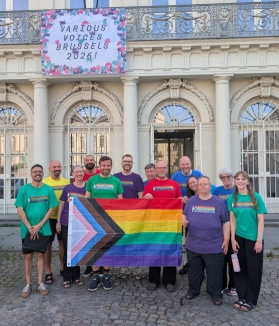
Various Voices 2026

The Rainbow Voices contingent just after our festival concertThe Rainbow Voices contingent just after our festival concert

I’m writing this on my way home from a trip with a group of singers from Rainbow Voices to Brussels to participate in Various Voices, a huge international festival for LGBT+ choirs. Its four days were packed with concerts by individual choirs running simultaneously in several venues, plus informal street concerts, and major shows at the end of each day, interleaved with a variety of social events and workshops.

It was an incredibly rich experience. There was so much that I found engaging, informative, and emotionally satisfying in my professional roles as musician and musicologist; not to mention simply as a human being (which obviously I only attempt on an amateur basis). I am trying to record some thoughts while the experience is still fresh but finding it hard to sort out what to think about first, there is so much to process.

On Conventionalised and Meaningful Gestures

During her keynote address at LABBS Harmony College, Blair Brown briefly explored the issue of the gestures singers use in performance. It came in the context of the over-riding principle that our performances should be honest and meaningful, that we should bring our best selves to the stage in order generate a genuine human encounter with our listeners.

All too often, she observed, a singer’s gestures can become conventionalised, using standard forms that thus appear to betoken a sense of ‘I’m doing this because it’s what people do,’ rather than being personally meaningful. Blair described the style of ‘churning’ hands one often sees in quartet performances as ‘transactional’ and attributed its use to a desire to impress rather than to connect. As such, it can be a barrier to communication.

On Repertoire and Empathy

I have been thinking a lot recently about repertoire choice in terms of an ensemble’s (or for that matter a solo performer’s) relationship with themselves and with their audience. This is in part a response to a point in Blair Brown’s keynote address at LABBS Harmony College, and in part with the way it both resonated and dissonated with a conversation I had just been having with a member of Rainbow Voices. I find myself with two imperatives in play, each valid, but on the face of it in direct opposition to each other.

Blair’s comments on repertoire choice were couched in terms of personal authenticity. She recommended choosing songs with which you feel a personal connection, so that you can sing them honestly. This isn’t just about you and your comfort, however, but about your obligations to your listeners. If they are vouchsafing their attention to you, they deserve a genuine experience of human connection. Don’t put yourself in the position where you have to bullshit your audience, is how she memorably (and indeed quotably) put it.

Spring Bank Holiday Weekend, New Version

Friday night at Birmingham PrideFriday night at Birmingham Pride

Well over half the Spring bank holiday weekends in my entire life have been spent at the British Association of Barbershop Singers Annual Convention. This year was the first of a new shape to the weekend, as it is also the weekend of Birmingham Pride which is a major fixture in Rainbow Voices’ calendar. Hence I spent the Friday night with them performing on the big stage at Pride, before heading down to Bournemouth to catch just the final day of the Convention.

Musings on Handel, Style, and Ideology

I recently returned to Gary C. Thomas’s classic essay ‘Was George Frederic Handel Gay?’ in the context of preparing to conduct an LGBT+ choir in the Hallelujah Chorus. For those who haven’t read it, the answer to the title’s question is: it is significantly more likely that he was gay than that he was straight. There’s a nice summary the reasons for that conclusion, including reference to research done by others since the original publication here.

Thomas writes not just about Handel’s homosocial social circle and activities, but also about how those have been discursively closeted off from his role as celebrated composer. Both in his own lifetime and since, there has been a general attempt to ‘normalise’ him as a properly manly (heterosexual) man, based largely on assertion, along with some invented evidence of ostensible female love interest.

Guidance notes on Repertoire Selection/Programme Planning

One of my projects as I settle in with Rainbow Voices is setting up processes to involve choir members in choosing our repertoire. The plan is to harvest ideas from choir members and our audiences, and then have small working groups to compile programmes from these ideas for our main performances each year. As part of that process I was writing some guidance notes for the working groups, and realised that they may be useful to other folk too, so am publishing them here. Indeed, a lot of what follows is drawn from materials I have written for conductor training and/or conversations I have had with conductors I have been mentoring, so some of you may have seen parts of this in other contexts already!

1. Sourcing material

  • Assume you’ll be considering at least 3 times as many pieces as you’ll actually sing, better up to 5 times as many
  • Crowd-source ideas from within the ensemble
  • Keep an ‘ideas bucket’ on the go all the time
  • Look both for song ideas (and then investigate choral arrangements), and for original choral music and existing arrangements (what choirs are already singing)
  • Youtube is your friend

...found this helpful?

I provide this content free of charge, because I like to be helpful. If you have found it useful, you may wish to make a donation to the causes I support to say thank you.


Archive by date

Syndicate content Syndicate content