

Choral

The Intervention and Enforcement Cycles, Part 1

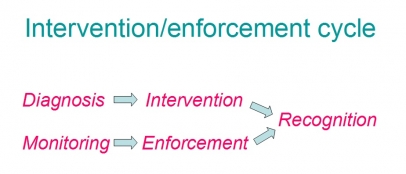
Following on from my post on rehearsal pacing, here at last is the first post about the Intervention and Enforcement Cycles. These describe the two fundamental processes that underlie the process of rehearsing an ensemble, and which can thus be used to analyse the detail of what we do with our choirs and maximise both the efficiency and effectiveness of our work with them.

Today I will outline how they work, and what the main differences are between them. In my next post I will discuss some common inefficiencies whereby directors let effectiveness leak out of their rehearsals. And the third post will give some extra hints and tips for good practice.

So, the two cycles look like this:
intervention

On Rehearsal Pacing

Rubric for rehearsal pacing: using my special 'almost legible' writingRubric for rehearsal pacing: using my special 'almost legible' writing
This is the first of a series of posts about efficient rehearsal techniques, about ways to get maximum bang for your rehearsal buck. The ones that follow are about the Intervention and Enforcement Cycles, which I keep mentioning with a promise to get around to blogging about them one of these days. That day is nearly here, but talking about rehearsal pacing is a useful set-up, so I’m doing this one first.

This diagram gives a usefully quick and dirty way of assessing the pace of a rehearsal by mapping patterns of activity on the choir’s experience:

So, long periods of talking will slow down the pace of rehearsal, and if combined with short bursts of singing, will send your singers home bored. Short periods of talking, conversely, give less opportunity for the singers to disengage. Combined with short bursts of singing, you get a fast-paced rehearsal, or with longer spans of musical time it becomes more relaxing.

How to build a warm-up

I wrote these notes for a session at Magenta’s retreat back in September in which a team of seven choir members prepared and led one element each of the warm-up. This was part of our general principle of handing round leadership in various activities as a way to develop the choir as a whole through experiencing different people’s perspectives, and the individuals within it through the act of leading. It was also intended as a way to raise everyone’s awareness of the elements of warming up and thus increase our sense of purpose as we engage with it each week.

As so often happens when I’ve written some notes for Magenta, I thought: you know, other people might find these useful too. Let’s publish this as a blog post. So here you go.

Surrey Harmony and the Musical Music Team

Rubric for rehearsal pacing: using my special 'almost legible' writingRubric for rehearsal pacing: using my special 'almost legible' writingThursday night saw me doing another session for a chorus’s music team, this time with Surrey Harmony. It was a rather different dynamic from my last session - a similar number of people, but this time the entire team from a single chorus rather than a couple from each of several choruses. What we lost in the opportunity to compare experience between different ensembles we gained in the opportunity to develop mutual understanding and shared working methods within the group.

(As an aside: there is a truism lurking in there about the learning process. What you can learn in any given scenario is to some extent a function of your own needs, beliefs and habits, but it is also a function of who you are learning with.)

Dr Jim’s Lemov Moments

At the moment when Jim Henry served as guest educator at the Directors Weekend I ran for the Ladies Association of British Barbershop Singers back in July, I had just spent two months dipping into Doug Lemov’s intensely useful book Teach Like a Champion. Having by then written a good handful of blog posts about how Lemov’s classroom techniques can play out in the choral rehearsal (and having made notes for more posts, which came along later), my brain was primed to spot them in action. And Dr Jim - seamlessly and without fanfare - provided a walking compendium of their application throughout the weekend.

Here are some of Dr Jim’s Lemov’s moments. You can see him in action in the clip above, but these comments come from notes made over the entire three days

More on Mouthing Words (and why not to)

The subject of why directors so often feel the urge to mouth the words as they conduct, and why it is a good idea to overcome this urge is a subject I have visited before. And I don’t need to say very much more than I did last time, so this will be a rather short post. But there was a communal penny-drop moment at the LABBS Directors Weekend back in July on this topic which I thought it worth sharing with you.

It was in one of the coaching sessions - three directors, half a chorus and a coach working together for 45 mins on helping the directors develop more effective technique. Often the directors wanted to work on how to become more expressive and communicative in their gestures, and often the answer was to do less at a full-body level so that the nuances of finger and facial expression weren’t constantly competing with other body parts for attention.

Learning with Lemov: Without Apology

In my early years as a lecturer, I was teaching a class on music analysis one day, when a student asked, ‘And why are we learning this?’ It’s the kind of question that can come over as quite confrontational, especially when you are feeling new to the game. But it’s also a good question to ask every so often. So I talked for a short while about why I thought the method we were looking at was useful to musicians (I suspect it was Schenker, but can’t actually remember for sure). The student accepted my answer, and we went on with the class, all of us feeling some relief that we weren’t wasting our time together.

This incident came back to me as I read Doug Lemov’s principle of teaching Without Apology. If we implicitly (or indeed explicitly) apologise for the content we deliver or the people we deliver to it, we lower expectations about both the achievements that are possible or the rewards that come from achieving it. If we don’t believe in what and who we teach/conduct, who will?

So that’s a principle that’s easy to agree with in the abstract, but let’s look at some of the ways it can play out in a choral context.

Confidence, Competence and the Dunning-Kruger Effect

If you've not seen this movie, I'd recommend it for all kinds of reasons, including its illustration of the Dunning-Kruger EffectIf you've not seen this movie, I'd recommend it for all kinds of reasons, including its illustration of the Dunning-Kruger EffectI wrote some time ago about the relationship between confidence and competence, and how when prioritising learning needs the former can often act as a reasonable proxy for the latter. There was, however, some interesting psychological research towards the back end of the last century that identified circumstances in which this correlation not only breaks down but becomes positively misleading.

The Dunning-Kruger Effect refers to the way that people who are grossly incompetent at a skill will cheerfully think they are quite good at it, as below a certain skill threshold you lack the knowledge and awareness to recognise how truly bad at something you are. Conversely, experts routinely underestimate how much better they are then the merely competent because one of the hallmarks of expertise is being able to do something fluently and without struggle.

This means that if you meet someone who describes an activity as ‘ not that hard’, they are likely to be either very very good at it or very very bad.

...found this helpful?

I provide this content free of charge, because I like to be helpful. If you have found it useful, you may wish to make a donation to the causes I support to say thank you.


Archive by date

Syndicate content Syndicate content