
Choral

A Cappella Spring Fest 2016

acsf2016

Most Sundays in the centre of Didcot are possibly not that exciting, but every March for the last 6 years, there has been an event worth travelling to. And this year’s A Cappella Spring Fest saw people come from as far afield as the Isle of Wight and Selby to participate in a day’s celebration of unaccompanied song in the Cornerstone Arts Centre. This was my second year as a tutor, and, like last year, I was leading the Contemporary A Cappella stream.

The format of the day was similar to last year’s, though the team tweaks marginally from year to year in response to feedback and experience. This time the ‘Fest Flash’ song - a song to be flashmobbed out in the shopping centre where Cornerstone is situated over lunchtime - took a much more central role for all participants. As before a core of singers who had opted to work on it during the morning formed the nucleus of the performance, but this time all other participants had enough work on it scheduled in also to join in.

On the Locus of Control, Part 2: The Conductor-Choir Relationship

So, my generalised musings on this concept brought me, as such musings so often seem to do, to wonder about the dynamic between a director and their choir. Given that the conductor’s job is to bring a collection of individuals together so that they operate musically as a single, coordinated, entity, how do they leave those individuals with a sense of their own agency?

This is not a new question, either to this blog or my wider writings - it is in many ways the question that Mike Brewer and I addressed in the Cambridge Companion to Choral Music through the metaphor of the social contract. But it is always worth a fresh view, especially when you have a useful conceptual lens like locus of control to examine it through.

I am going to look through this lens at two different levels of magnification - first at the big picture of a director’s overall approach to decision making, then in finer detail at the specifics of what we do during the flow of rehearsal.

Two Penny-Drop Moments

Okay, so one person’s penny-drop is another person’s blindingly obvious, but I thought I’d share two ‘Aha’ moments I had this week so you can feel smug about how you’ve known about them for years. Both were about rehearsal planning, and both arose from specific circumstances that drew things I half knew but hadn’t thought about in detail into conscious awareness.

1. The Rehearsal Focal-Point

Attention span graphAttention span graph
So, we’ve known about the attention-span graph for yonks, and I am accustomed to following its implications in rehearsal planning by scheduling new stuff during the phase just after the warm-up where people’s cognitive capacities will be at their peak. ‘New stuff’ here mostly means new repertoire, though it may mean taking on a new challenge with established repertoire in the context of a particular performance goal. But you need something new to be working on most of the time to keep people feeling like this week’s rehearsal offers something different from last week’s or next week’s.

On Sopranos, Stereotyping, Sexism and Strain

I have been mulling over an interesting blog post shared by a friend recently. The writer, Mari Valverde, has some very interesting things to say about the misogyny implicit in cultural stereotypes of the soprano voice and the practical consequences for how composers and arrangers tend to write for it. I think she is really onto something, and she has made me think about the question of voice-part stereotypes (which I explore in various ways in both my books) in some new ways. I also suspect there are some aspects of the question she is tangling up, so I wanted to spend a post teasing out how my own thoughts are developing in the light of her ideas.

So, the following are factors that feed into the phenomenon of exhaustingly high tessituras in soprano parts:

Choosing Relatable Music

It’s not hard to get people to agree that it’s good to perform music that an audience will be able to relate to. It’s not always the highest priority - some people might think first about beauty, or about spiritual depth - but a dialogue about musical values will usually find the common ground between these more abstract qualities and the importance of a meaningful experience that connects performers and listeners.

This does not necessarily make it easy, of course, to reach agreement as to what constitutes ‘relatable’ music.

I had two conversations in quick succession recently that brought this into relief for me. In both cases the issue arose through differences of opinion between a choir director and some of their singers, though in rather different genre contexts. It gradually emerged that people were using the concept of ‘relatable’ music as a code for ‘not that stuff you want to do that I don’t like’.

Self-Deprecation and the Conductor

These thoughts initially arose in response to working with the participants on the Association of British Choral Directors’ Initial Conducting Course at the weekend. But as I mulled on them on my way home I realised that, while there are ways in which that social context amplified the issue, it’s a general one for choral directors in real life. When I describe the form of behaviour I mean, you’ll recognise it.

So, this is what I was seeing: a conductor stands up in front of the singers they are about to direct, and in various verbal and non-verbal ways, they put themselves and their work down. They soften and lower their posture, and drop their gaze. They describe the activity they’re about to lead as a ‘little’ warm-up or ‘a bit of an exercise’. They express hope that it will work, and apologise for tiny stumbles that would otherwise not have been noticed.

(I say ‘they’; it may be ‘we’. I’m going to have to watch myself here.)

The Intervention and Enforcement Cycles, Part 3

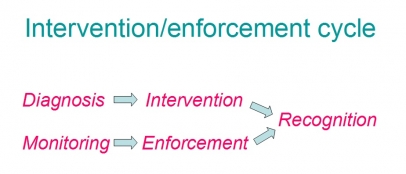
Having outlined the basic framework, and analysed some of our commonest errors, it is time to finish with some extra advice on how to use the Intervention and Enforcement Cycles to best effect.

  • Positive framing: “Do this!”

    Don’t breathe at the end of this phrase
    Join these two phrases together

    These are identical in intent as interventions (or, indeed, enforcements), but the second is a far easier instruction to follow. Likewise:

    Less volume in this section
    More hushed here

    If we always frame our instructions in terms of things to add to the performance, rather than things to take away, it keeps people focused on what you are achieving together. This means that not only is it more emotionally satisfying (succeeding at something feels better than merely not failing at something), but it gives your singers more control over their developing skills to think about them in terms of actions they can do rather than mistakes to avoid.

The Intervention and Enforcement Cycles, Part 2

intervention

Having looked in my post last week about what the Intervention and Enforcement Cycles are and how they work, it’s time to have a look at how to use them more efficiently and effectively. So, here are some of the commonest forms of inefficiency in rehearsal that dilute our effectiveness.

...found this helpful?

I provide this content free of charge, because I like to be helpful. If you have found it useful, you may wish to make a donation to the causes I support to say thank you.


Archive by date

Syndicate content Syndicate content