
Choral

On Managing Persistent Mistakes: Part 1 - Prevention

There was an interesting conversation recently in a Facebook group for chorus directors about the challenge of a singer who was consistently getting some notes wrong. They were able to sing the right notes correctly in section, but reverted to the wrongly-learned version when back in the full ensemble.

The director who raised the question framed it in terms of the dilemmas of expectation-setting and qualification for participation in performances. They didn’t want to be the kind of group who excluded people, but equally the errors were disturbing other singers and obviously had an impact on the quality of performances. The ensuing discussion included a lot of wisdom about setting up systems to manage quality control in the context of individual development. The shared goal was to support people to succeed.

On Musicking in the Moment

Music is, by definition, a time-based art-form, so producing sounds one after another is inherent to its praxis. But, as I explored a few years back, the unrelenting march of musical time can create unhelpful pressures on musicians, and, when not actually performing, it is often valuable to suspend time and let moments elongate themselves around you.

I recently remembered a lovely exercise that Jim Henry did with the White Rosettes at the LABBS Directors Weekend in 2015. He had them sing the target vowel of a particular syllable in the lyric of their song, but without knowing until he signalled whether they were going to sing that word, or another with the same vowel. I forget which actual words were involved, but for example sustaining ‘moo’, without knowing until the signal whether the word was going to become ‘moon’ or ‘mood’.

How Listen and Do at the Same Time

One of the biggest challenges that novice choral directors face is learning how to listen to the singers at the same time as directing them. It sounds so simple, written like that, and is clearly fundamental to the conductor’s task, but as people new to the activity invariably discover, it is easier said than done.

You see, we each only have the one brain each. And if that brain needs to pay a lot of attention to unfamiliar motor skills in the context of complex musical content, it doesn’t have very many cognitive resources left over to dedicate to the sound coming into it. As one acquires experience, the raw panic of overwhelm subsides, but the challenge remains. There is a lot going on when you conduct a choir – all those people singing at once, each with their specific musical and personal needs - and we still have only the one brain with which to process it all.

Musings on Section Leadership

This post emerges from having a number of conversations over quite a long period of time, and noticing a pattern that needs interrogating. I don’t know if by the end of it I’ll have any answers, but I hope to have a better handle on the questions, which is arguably the most useful stage.

The conversations have been with choir directors, mostly (though not exclusively) of barbershop choruses, but all groups in which section leaders play a significant role in the groups’ processes for learning music. The choruses have included all-male, all-female and mixed groups, ensembles of a range of achievement levels, and are based in several different countries. What they have in common are reports of a particular dynamic within one of their sections, whereby the section as a whole is perceived as fragile, despite having a very strong singer for their leader.

Thoughts on Legato

I have been re-reading Joszef Gat’s The Technique of Piano Playing, which I last read in its entirety age 20. I have dipped it into it maybe a couple of times since, but it’s safe to say there’s a lot in there that I had completely forgotten about. It is that curious mixture of, ‘Oh, that’s interesting and insightful,’ and, ‘Really? You’re kidding me!’ that you often get in the writings of practical musicians, and as such is a very rich reading experience.

Anyway, as you’d expect in a book on this subject, he talks about legato, which is a notorious challenge for pianists. In common with many writers, he holds up singing as the ideal model for this, contending that even string instruments can only achieve a partial legato. Whilst on the one hand (literally!) the bow offers continuity, on the other, the act of forming pitches by stopping strings means you are effectively playing a different string for every note, as each is a different length.

Getting into the detail with abcd

Analysis of one of the MD's four roles: the others are leader, musician, and teacherAnalysis of one of the MD's four roles: the others are leader, musician, and teacher

I spent Saturday up in Manchester leading a day course for the Association of British Choral Directors entitled, ‘Choral Conducting: A Beginner’s Guide’. As the title implies, the participants were mostly conductors in the early stages of their journey – all already good musicians, but with varying amounts of experience leading choirs, and little or no prior formal training in technique.

There is of course far more to choral conducting than you can cover in a day (opportunities here to plug the longer abcd Initial Course which does a great job of laying solid foundations for onward growth!), but you can get people up to the point where they can be confident they can get a group of singers safely into the music and out again, which is the heart of the job.

On Recordings, Post-COVID Vulnerability, and Overcoming the Fear of Being Heard

This is a long title, and it’s going to be a longer than usual post. But I felt it all belonged together rather than being chunked up, as all the different elements are related to each other. It’s partly about coping with human beings, and partly about the nitty-gritty of learning activities, but as we experience the two things simultaneously it seemed best to consider them together.

Conversations with a number of chorus directors at LABBS Harmony College revealed a pattern of common experiences of chorus members having unexpectedly strong negative reactions to things that in the past might have seemed perfectly routine. These often revolved around being asked to record themselves to check on their note-accuracy, and part of this post will be about managing that specific issue.

Prioritising Connection at LABBS Harmony College

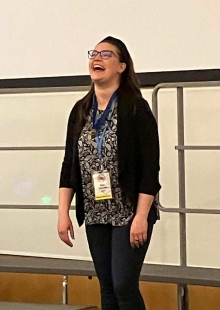
Leading a vocal development session with a laughLeading a vocal development session with a laughThe weekend saw the Ladies Association of British Barbershop Singers holding their first full Harmony College since 2019. It was fully booked before the closing date for registrations, confounding our expectations that numbers might still be a bit down, as they were for last year’s education events. It was superbly masterminded by its Dean, Debi Cox, who brought her deep understanding of both educational needs and logistical realities to the task. If you see her, tell her thank you again from us all.

Our guest educator this year was Kim Newcomb, and whoever had the idea to invite her also needs to feel pleased with themselves. Kim is not only highly skilled as a singer (most famous at the moment for being a reigning Sweet Adelines International quartet champion), she is also a professional educator, and, it turns out, profoundly encouraging as a human being. One has the sense that she has always been nice, but she has also developed a deep moral commitment to being kind and supportive that underpins her praxis.

...found this helpful?

I provide this content free of charge, because I like to be helpful. If you have found it useful, you may wish to make a donation to the causes I support to say thank you.


Archive by date

Syndicate content Syndicate content