

A Cappella

Singing on the Off-Beat, Part 2

In my last post I shared some suggestions to help people develop the musicianship skills needed for singing on the off-beat. The second stage of the process is to consider the music that is asking you to deploy these skills and asking if the composer and/or arranger are facilitating your success or creating obstacles.

You see, off-beat passages are a classic example of the kind of thing a notation program can do really well, as it just produces a literal rendition untroubled by the sense-making that the human brain brings to the process of singing. And whilst sometimes (well, quite often) the problem is patchy musicianship skills in the performers, sometimes the problem is also over-optimism on the part of a writer who hasn’t spent enough of their life in rehearsal trying to help people with patchy skills achieve rhythmic security.

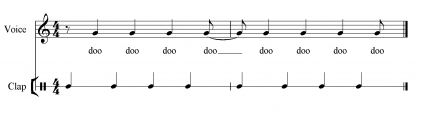
I left you last time with the following exercise, which reproduces the kind of thing you quite often see in a cappella arrangements, and turns out to offer a useful case study to explore this central musical question.

offbeateg6

Singing on the Off-Beat, Part 1

Every so often, it seems that everyone I talk to is grappling with the same challenges. Well, maybe not everyone, but enough to feel that we have something of a theme going on, and thus an opportunity to try to be helpful to multiple ensembles at once.

A conductor recently messaged me with the following clear summary of the problem:

a couple of our sections are having real trouble getting into singing off the beat. A good number of our songs have crotchet notes aligned on the half beat and they're often getting pulled into alignment with the beat instead. I wonder if you have any good ideas for how we can encourage off-beat singing?

Arranging for a Low Lead

This is kind of a niche post, as it’s about a specific challenge that we don’t come across very often. I have been arranging recently for a barbershop quartet which has a lead who more usually sings bass, which brings the melody into a rather lower tessitura than one usually uses in TTBB barbershop. This is a distinct challenge from arranging with the bass on the melody, which we do fairly frequently, although some of the things learned doing that turn out to be relevant.

Interestingly, the singer specified reference performances of the songs in the keys he wanted to sing them in, so we’re working with an established performance history of the songs in a lower tessitura. Also interesting was that a casual listen to these recordings gave me an impression of richness and warmth, but not particularly low pitch. I found myself surprised when I actually checked what keys the songs were in – and realised that particularly in one case that I had therefore a rather more challenging task than I had first imagined!

Spring Bank Holiday Weekend, New Version

Friday night at Birmingham PrideFriday night at Birmingham Pride

Well over half the Spring bank holiday weekends in my entire life have been spent at the British Association of Barbershop Singers Annual Convention. This year was the first of a new shape to the weekend, as it is also the weekend of Birmingham Pride which is a major fixture in Rainbow Voices’ calendar. Hence I spent the Friday night with them performing on the big stage at Pride, before heading down to Bournemouth to catch just the final day of the Convention.

Harmonic Choices and Expressive Range

One of my stock phrases when coaching expressive performance is: The lyrics tell us what is going on, the music tells us how to feel about it. Like most stock phrases it lacks nuance in some contexts, but is a safe and useful generalisation that focuses our attention on the role that of aspects of a song that can sometimes seem quite intangible play in its communicative impact.

All musical elements play a part in shaping the sense of characterisation and emotional narrative - melody, rhythm, texture, voicing – but today I am thinking particularly about harmony. For there is a particular challenge that faces the arranger when working within the defined harmonic vocabulary of contest barbershop: how do you shop a song without making it sound just like every other barbershop song you’ve ever heard?

Building Resonance with SpecsAppeal

SpecsAppealApr25

I’ve just spent a happy Sunday with SpecsAppeal, working with them on techniques to help them build their unit sound as a quartet. I’ve known them for some years, having arranged for them a number of times, but this is the first time I’ve actually coached them. I have enjoyed seeing how they have grown as an ensemble over time, and we all came into the day with a sense of alignment between what they are currently focused on and what I felt I could help them with.

Sometimes a coaching session is all about exploring a particular repertoire, and you might have thought that this might have been the case on Sunday as I had arranged both of the songs we worked on for them. But in fact, there was relatively little they needed from me in terms of concept or shape; they had picked the songs and knew exactly what they wanted to do with them, so other than helping them execute those intentions more effectively in a couple of places, there was very little we did that wouldn’t apply to any song they might have chosen to sing.

Mistake-Busting Method for Quartets

I mentioned in my recent post about a coaching session developing a rehearsal protocol for quartets to support each other in correcting notes that had been learned incorrectly. It felt like it deserved a post in its own right, as it’s something lots of us need to deal with and so it would be useful to work through not just what to do, but why this procedure helps. Plus of course having its own post will make it easier to point back to when I meet other people with the same need!

So, learning any phrase involves generating neural pathways that encode the act of singing it; the more you repeat that act, the stronger the neural pathway becomes and thus the more automated. This is very useful, until it turns out that you have been practising a wrong note, when the strength of your practised neural pathway keeps pulling you back when you’re trying to correct it.

Saturday Singing with Cantare Lunedì

CantareLunediApr25

If you are familiar with Italian at all, you will not be surprised to learn that the quartet I spent Saturday afternoon with usually sings on Mondays. It was a session focused on techniques and methods rather than preparing for a specific performance occasion: the repertoire was chosen as useful vehicles to work on, but the intent was to work on things that could then be transferred to all their other songs.

There were two broad areas we focused on: first, vocal technique, second, ensemble techniques. They arrived as four singers comfortably in control of their vocal apparatus (I note that the tonal centre did not waver all afternoon), but with potential to develop greater resonance.

...found this helpful?

I provide this content free of charge, because I like to be helpful. If you have found it useful, you may wish to make a donation to the causes I support to say thank you.


Archive by date

Syndicate content Syndicate content